
Services
Ultrasound Diagnostics
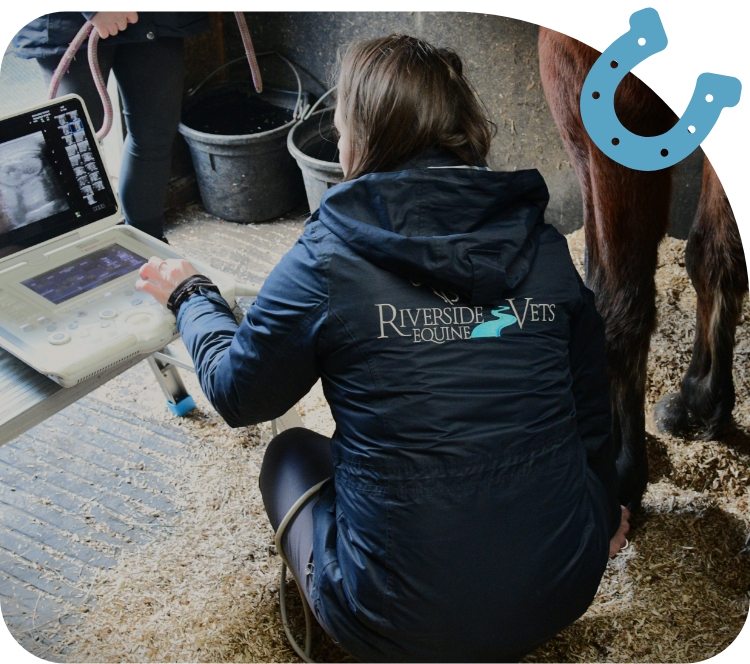
Our state-of-the-art portable ultrasound system delivers exceptional image quality, allowing us to examine a wide range of internal structures quickly and accurately, either at your yard or on-site. Using a variety of specialised probes, we can assess tendons and ligaments in lameness cases, perform abdominal scans, diagnose pregnancy, and evaluate reproductive and other internal organs.
Advances in ultrasound technology mean we can do far more than simply visualise structures. We are able to take precise measurements, label findings, and store high-resolution images and video clips for ongoing monitoring and comparison. This is particularly valuable for tracking healing progress or subtle changes over time.
Ultrasound is a safe, non-invasive diagnostic tool that provides real-time insight, helping us make informed decisions and tailor treatment plans to achieve the best possible outcomes for your horse.
Endoscopy & Gastroscopy
We offer advanced endoscopy using both a full-length video gastroscope and a smaller video bronchoscope, allowing us to investigate a wide range of conditions in detail.
Gastroscopy is primarily used to diagnose Equine Gastric Ulcer Syndrome (EGUS), while our bronchoscope enables thorough assessment of the upper and lower respiratory tract. These tools are invaluable for investigating poor performance, coughing, nasal discharge, and other internal concerns.
All procedures are carried out under sedation in the comfort of your horse’s own stable, minimising stress and avoiding the need for hospital visits. High-definition video imaging allows us to examine structures such as the stomach, larynx, windpipe, lungs, and guttural pouches in real time.
Where needed, we can also collect samples during the procedure to support accurate diagnosis and targeted treatment plans.
Digital X-ray
Our fully portable digital x-ray system allows us to produce high-quality images quickly and efficiently, right at your horse’s stable. Images are available within seconds and can be viewed immediately on-site, enabling us to assess findings and discuss them with you during the visit.
Advances in digital radiography mean we can now image a wide range of areas in the field, including the limbs, hocks, stifles, spine, head, and teeth. This makes x-ray an invaluable tool for investigating lameness, injuries, dental problems, and conditions such as arthritis or laminitis.
All images are stored digitally, allowing for detailed review, sharing with specialists if needed, and ongoing comparison over time.
Pre-Purchase Examinations (Vettings)
A pre-purchase examination is an important step in ensuring you make an informed decision when buying a horse. Our experienced vets provide thorough, objective assessments tailored to your intended use, helping you understand any potential risks before purchase.
We offer both two-stage and five-stage vettings, carried out at the horse’s location. The examination includes a detailed clinical assessment, evaluation of conformation and movement, and where appropriate, strenuous exercise and recovery monitoring. Additional diagnostics such as x-rays, ultrasound, or blood sampling can also be performed if required.
Following the examination, we will clearly explain our findings and discuss their implications for the horse’s suitability for your needs. A full written report is provided for your records.
Our aim is to give you clear, honest advice so you can proceed with confidence.
Equine Dentistry
We provide high-quality, thorough dental care to support your horse’s health, comfort, and performance. All dental procedures are carried out under sedation, ensuring a calm, safe experience while allowing us to perform a detailed examination of the entire mouth and oral cavity.
Dental disease is a common but often overlooked cause of poor welfare in horses. It can lead to behavioural changes, reduced performance, weight loss, and quidding, yet many horses show few obvious signs. Regular, thorough examinations are therefore essential, with most horses benefiting from a dental check at least every 12 months.
Our vets can diagnose and treat a wide range of dental conditions during the same visit, helping to prevent more serious issues developing. Sedation is included in the cost of a dental rasp, giving you complete transparency and excellent value. Routine dental care is often conveniently carried out alongside annual vaccinations.
Emergencies
We provide emergency veterinary care for our patients 24 hours a day, 7 days a week, 365 days a year. Our own vets are at times supported on our out-of-hours rota by our trusted colleagues at Equicall, ensuring continuous, reliable cover. In an emergency, your horse will always be seen by a highly experienced equine vet, giving you confidence that expert care is available whenever you need it.
Exports
If you are planning to export your horse—whether to Europe or further afield—you will require an Export Health Certificate issued by DEFRA and completed by an Official Veterinarian (OV).
Export requirements vary depending on the destination country and your horse’s recent travel history. These may include specific blood tests, swabs, and vaccinations. It is the owner’s responsibility, often in conjunction with their chosen shipping agent, to ensure all requirements are met prior to export. We strongly recommend planning well in advance to allow sufficient time for any necessary testing and certification, helping to ensure a smooth and stress-free process.
Our vets, Gemma, Nick and Charles, are Official Veterinarians and are able to complete export certification, as well as guide you through each step of the process.
Worming
Effective worm control in horses is now best achieved through a targeted approach based on regular faecal sample testing, rather than regular blanket deworming. Faecal egg counts (FECs) allow us to assess an individual horse’s parasite burden and determine whether treatment is actually necessary. This helps identify “high shedders” that require more frequent intervention, while avoiding unnecessary treatment in low-risk animals.
Routine blanket deworming is no longer recommended because it accelerates the development of resistance to the wormer products. Overuse of wormers exposes parasites to repeated treatment, allowing resistant populations to survive and multiply. As resistance increases, commonly used products become less effective, limiting future treatment options and posing a significant risk to equine health.
Testing is typically carried out every 8–12 weeks during the grazing season, when parasite transmission is highest. Results guide the selective use of worming products, ensuring the right product is used at the right time. However, faecal testing does not detect all parasite stages; encysted small redworm larvae and tapeworm infections may require additional testing or strategic treatment at certain times of year.
Riverside Equine Vets can design a tailor-made, comprehensive testing-led plan for your horse to ensure effective, responsible, and sustainable parasite control.
Lameness Investigations
Lameness can be complex, and accurate diagnosis is key to successful treatment and long-term soundness. Our experienced vets take a thorough, systematic approach to identifying the source of lameness, combining detailed clinical assessment with advanced diagnostic techniques.
We use sequential nerve and joint blocks to precisely localise the source of pain, supported by high-quality imaging such as digital x-ray and ultrasound. This allows us to reach an accurate diagnosis, even in subtle or challenging cases.
Treatment plans are tailored to each horse, focusing on reducing inflammation and improving the health and function of joints, ligaments, and tendons. Options may include intra-articular therapies such as corticosteroids, hyaluronic acid, biologics, and Arthramid, alongside systemic treatments including intravenous hyaluronic acid, Arthropen, bisphosphonates, and appropriate pain relief.
A Holistic Approach
We believe the best outcomes are achieved through a collaborative, whole-horse approach. Alongside veterinary treatment, we work closely with farriers, saddle fitters, and physiotherapists to optimise foot balance, saddle fit, and develop targeted rehabilitation programmes. This integrated approach supports recovery, improves performance, and helps maintain long-term soundness.